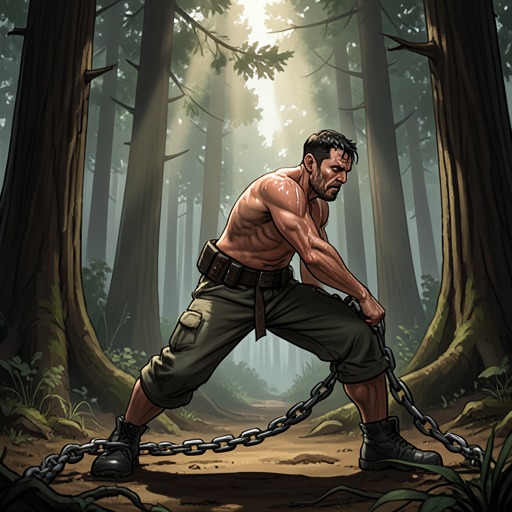
Eleven-Mile Cutoff Bridge construction and inaugural crossing
Train DreamsEleven-Mile Cutoff Bridge construction and inaugural crossing is a defining episode in Robert Grainier’s working life: a railroad gang completes a bridge over a gorge, then watches the first locomotive cross it, celebrating a practical triumph that Grainier experiences as emotionally ambiguous. The project embodies the material power of organized labor while preserving the sense that every improvement is built through bodily risk, altered landscapes, and the difficult conversion of wilderness into infrastructure.
Construction and Purpose
The bridge spans a 112-foot interval of air above a gorge sixty feet deep. Its purpose is explicitly economic and logistical: by eliminating a long curve around the gorge and through an adjacent pass, it saves the Spokane International Railway from maintaining an eleven-mile stretch of rails and ties. The name Eleven-Mile Cutoff Bridge therefore records not only its location but the distance and expense that the structure removes from the railway system.
The bridge is made by a railroad gang rather than presented as the achievement of a solitary engineer. Grainier stands among the workers who have assembled it, and the completed structure is the visible result of coordinated physical labor. The men’s work belongs to a wider industrial pattern in which railways cross obstacles by mobilizing large crews, timber, machinery, and time. A natural gorge is transformed into a controlled passage, and the railway gains a shorter, more efficient route through the landscape.
The First Locomotive Crossing
Forty-one days after the relevant work, the gang gathers for the inaugural crossing. Mr. Sears stands beside the single locomotive and raises a four-shooter as the signal to begin. At the gunshot, the engineer trips the brake and jumps out of the machine. The locomotive then moves very slowly across the tracks and over the Moyea toward the opposite side, where a second man waits to board it and stop it before the track ends.
The crossing is therefore both ceremonial and precarious. The men do not simply send the engine across and watch from a safe distance: the engineer leaves the machine, and another man must catch it at the far end. The locomotive’s slow progress makes the bridge’s empty space perceptible, while the need to halt the engine before the unfinished track runs out keeps danger inside the celebration. When the machine reaches the other side, the workers cheer and whoop, turning a hazardous test into a communal victory.
Grainier’s Response
Grainier joins the cheering, but he feels sad and cannot explain why. That unexplained sadness is the episode’s decisive reversal. The scene appears to demand uncomplicated pride: men have built a bridge, a locomotive has crossed it, and the railway has gained a more efficient route. Yet Grainier’s emotional response refuses the expected conclusion. His participation in the shouting does not erase the private disturbance beneath it; he celebrates outwardly while sensing something he cannot name.
The crossing remains with him as a source of desire. The experience makes Grainier hungry to work on other massive undertakings, where swarms of men clear portions of the forest and assemble structures over otherwise impassable chasms. The bridge thus gives him an appetite for scale. He is drawn toward projects that are bigger, longer, and deeper, even though the first great accomplishment has already shown him that industrial triumph can produce grief as well as exhilaration.
From Bridge Work to the Wider Forest
In 1920 Grainier follows this impulse to northwestern Washington to help repair the Robinson Gorge Bridge, described as the grandest undertaking yet. That bridge crosses a gorge 208 feet deep and 804 feet wide and can support an engine and two flatcars of logs. Nearly thirty years old, it is wobbly and terrifying; nobody rides the cars across it, not even the engineer, and the brakeman catches the car at the other end. The contrast with the Eleven-Mile Cutoff crossing enlarges the earlier episode: railway infrastructure is not uniformly secure, and even an established bridge can remain a frightening compromise between ambition and physical limits.
After the repairs, Grainier moves higher into the forest with the Simpson Company. There he joins a timber system of corduroy roads, temporary rails, six-horse teams, cable, and flatcars. The rails exist to carry timber out, while more than forty men bring logs within reach of the railway landing. At the landing, an old wood-burning Steam donkey uses two iron drums—one paying out cable and the other winding it in—to drag logs forward while sending out its hook for the next choker. The logs then travel across Robinson Gorge and down the mountain toward the railway network of the American continent. The bridge project is consequently not an isolated feat but an entry point into a larger chain that converts forests into transportable capital.
Labor, Risk, and Industrial Progress
The bridge’s achievement is inseparable from the danger of the labor that surrounds it. In the woods, Grainier works as a choker, looping cable around eighteen-foot spruce logs after sawyers fell them, limbers clear them, and buckers cut them. He relishes the strain, exhaustion, and rest that follow the work, as well as the grand size of the forest and the feeling of being protected by countless trees. But Arn Peeples warns that the trees themselves are killers: a sawyer may judge a fall correctly ninety-nine times, while the hundredth can send a massive trunk into his face.
The gang, sometimes more than forty men and never fewer than thirty-five, works from sunrise to suppertime, shouting communications over the machinery and changing the mountainsides through felling and bucking. Pitch sticks to their beards, sweat carries dust into the creases of their bodies, and the odor of resin abrades their throats and stings their eyes. Their tents are patched with burlap and, according to Arn Peeples, had originally served as Union infantry tents during the Civil War and later housed U.S. Cavalry in the Indian campaigns. The bridge therefore belongs to a world where infrastructure is built by bodies exposed to an inherited material history of war, extraction, and danger.
Arn Peeples’s death gives that danger a blunt and ironic form. He is not destroyed by the explosive machinery he imagines might kill him, but by a dead branch from a tall larch, a “widowmaker.” The blow leaves him dizzy, feverish, and forgetful; days later he dies in bed, apparently comfortable beneath the covers. His friend Billy remembers that he never cheated or stole, and the captain says the men cannot take a day off because the company and the war require them to continue. The demand for spruce, intensified by the war in Europe, places the men’s private losses inside an economic system that treats uninterrupted production as more urgent than mourning.
Infrastructure and Its Afterlife
The bridge’s significance extends beyond its inaugural crossing because railway routes in Grainier’s world serve as channels for both connection and exclusion. His earliest memory is of Chinese families being forcibly loaded onto flatcars at Fry, while decades later the community displaced toward China Basin has dispersed. The same railway system that represents movement and modern connection is also implicated in the organized removal of people. Its tracks can shorten routes and carry machinery, workers, timber, refugees, or bodies; they do not possess a single moral function.
The fragility of such systems becomes especially visible during the Moyea Valley fire. When Grainier returns from the Robinson Gorge work in the summer of 1920, the fire has consumed the valley, and the northbound Spokane International Railway is stopped in Bonners Ferry until the blaze subsides and rain soaks the Idaho Panhandle. Grainier walks twenty miles along the Moyea River Road through smoke and ash toward the destroyed homesite, then later rides the train through the burned valley. The train makes a great noise but cannot wake the dead landscape. In this juxtaposition, the railroad’s power to move people and goods contrasts with its helplessness before catastrophe.
The bridge’s ideal of controlled passage also contains the possibility of death. In 1930 Kootenai Bob, drunk for the first time during Prohibition, wanders onto the tracks and is run over by four or five trains. His remains are scattered for a quarter mile, and members of his people collect fragments the crows have missed. The railway that once carries the triumphant first locomotive across a gorge becomes a site where a human life is broken apart by repeated mechanical passage. The contrast does not cancel the bridge’s achievement; it gives that achievement a harsher historical frame.
The construction and inaugural crossing of Eleven-Mile Cutoff Bridge ultimately defines progress as an unstable mixture of mastery and vulnerability. It saves the Spokane International Railway an eleven-mile burden, demonstrates what a coordinated gang can build over open air, and directs Grainier toward still larger undertakings. Yet the crossing’s unexplained sadness, the dangerous labor required to make such structures possible, the fire that defeats transportation, and the death beneath the trains prevent the bridge from standing as a simple monument to progress. It is both a passage and a warning: a human-made connection suspended above an emptiness that remains visible beneath it.